
Why Should Kids Learn English? A Simple Step-by-Step Guide for Parents
At some point, almost every parent asks the same question:
“Does my child really need to learn English?”
Maybe your child already has English at school.
Maybe they know a few words from cartoons and games.
Maybe they understand more than they can speak.
Or perhaps you are simply wondering whether now is the right time to start.
The good news is that learning English does not have to feel like adding another difficult subject to your child’s life.
When children are given the right environment, English can become something they use, enjoy, and gradually grow confident with.
And you don’t need to turn your home into a classroom to help them.
Let’s look at it step by step.
Why is English important for children?
English is much more than another school subject.
As children grow, they are likely to encounter English through books, games, technology, travel, entertainment, education and communication with people from other countries.
But there is another benefit that is easy to overlook.
Learning a language gives children another way to express themselves.
A child who can say:
“I like this.”
can eventually learn to say:
“I like this because…”
And later:
“I don’t agree because…”
The goal isn’t simply to make children memorize more English words.
It’s to help them develop the ability to understand, express themselves and communicate.
Research and guidance on children’s language learning also emphasizes that young learners benefit from meaningful, enjoyable activities, stories, conversation and regular exposure rather than treating English purely as a grammar exercise.
Step 1: Start with English that your child actually cares about
This is where many parents accidentally make English harder than it needs to be.
Imagine telling a six-year-old:
“Today we’re going to learn 20 new vocabulary words.”
Not very exciting.
Now imagine saying:
“Let’s learn the names of five animals and then see if you can guess which animal I am.”
Suddenly, English has a purpose.
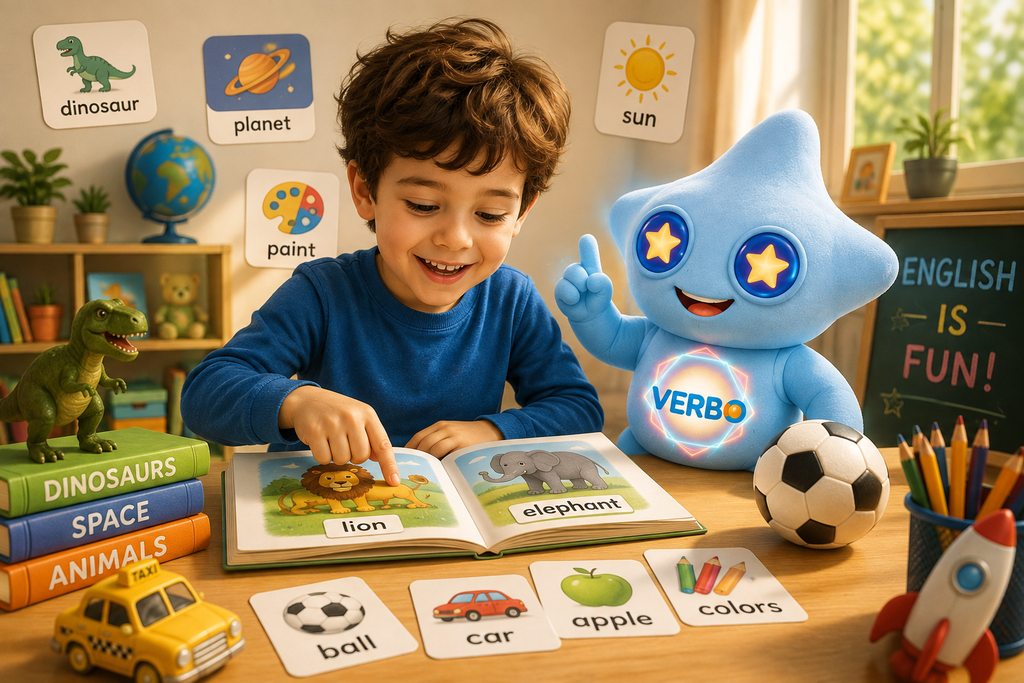
If your child loves dinosaurs, start with dinosaurs.
If they love football, use football.
If they love drawing, talk about colours and pictures.
If they love stories, use stories.
The subject can be English. The world around the child can still be theirs.
Step 2: Don’t worry if your child doesn’t speak immediately
This is something many parents misunderstand.
A child may understand quite a lot of English before they feel comfortable speaking it.
Listening comes first.
The child hears the same words repeatedly.
They begin to recognize patterns.
They connect words with objects, actions and situations.
Then, gradually, they begin using those words themselves.
So if your child doesn’t suddenly start speaking in complete English sentences after a few lessons, don’t panic.
Learning a language is a process.
The British Council notes that young children can have a period where they understand English before they begin speaking it, and that their understanding can be greater than their spoken ability.
The important thing is to give them opportunities to keep listening and communicating without making them afraid of mistakes.
Step 3: Make English part of everyday life
You don’t need to spend two hours every evening teaching English.
Small moments can be powerful.
Try simple things like:
At breakfast:
“Do you want milk or juice?”
Getting dressed:
“Where is your blue shirt?”
Playing:
“What colour is this?”
Before bed:
“What was your favourite part of today?”
At first, your child might answer with one word.
That’s okay.
The important thing is that English is becoming something they use, rather than something they only study.
Stories, songs, games and everyday routines are commonly recommended ways to make English meaningful for young learners.
Step 4: Let them make mistakes
This might be one of the most important rules.
Your child says:
“I goed to school.”
Don’t immediately say:
“Wrong! It’s ‘I went to school.’”
Instead, you can naturally respond:
“Oh, you went to school! What did you do there?”
Your child hears the correct structure without feeling embarrassed.
Because the goal isn’t to create a child who is afraid of making mistakes.
The goal is to create a child who thinks:
“I can try.”
And that confidence matters.
Step 5: Give your child someone to actually talk to
This is where things can become difficult for parents.
You can introduce vocabulary at home.
You can read stories.
You can play games.
You can watch English content together.
But eventually, your child needs something very important:
real communication.
Someone needs to ask them a question.
They need to answer.
Someone needs to listen.
They need to explain something.
They need to hear English spoken naturally and have a reason to respond.
This is one reason individual lessons can be valuable.
Instead of simply watching English, the child becomes part of the conversation.
So where does VerbaKid fit in?
This is exactly the problem we wanted to solve.
VerbaKid is an online English school designed specifically for children.
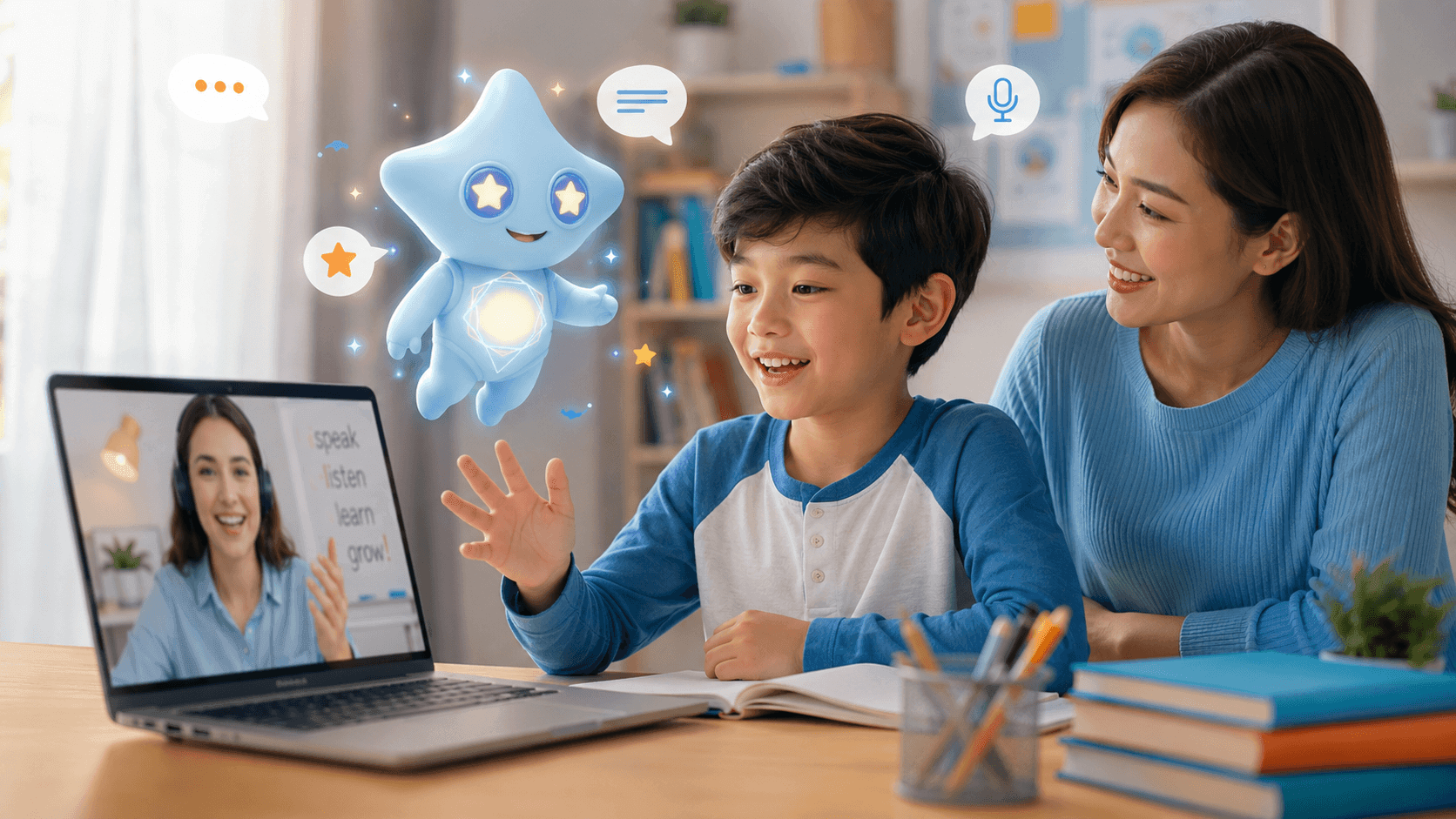
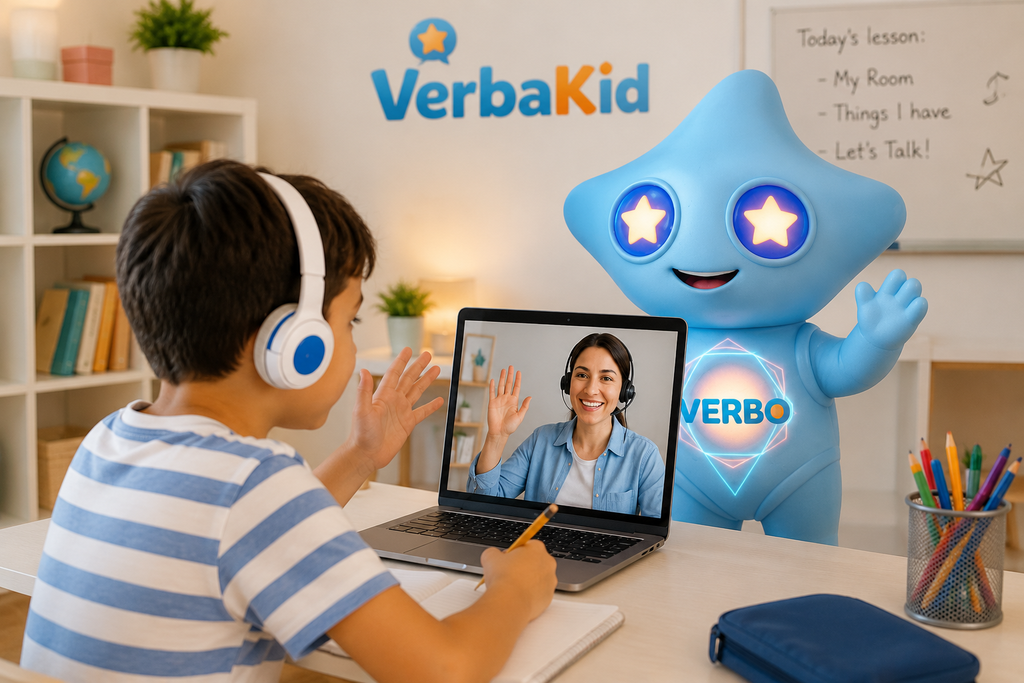
The lessons are live and 1-to-1, with a real teacher.
That means your child isn’t simply watching a recorded English lesson.
They are talking to someone.
Listening.
Answering questions.
Learning new vocabulary.
Practising sentences.
Playing language-based activities.
And gradually becoming more comfortable using English.
You can learn more about how VerbaKid works and what makes our approach different.
Learning English shouldn’t feel like homework
We believe children learn best when they are interested in what is happening.
That’s why VerbaKid lessons can use stories, characters, challenges, pictures and conversation to give children a reason to use the language.
And of course, there’s Verbo ⭐
Verbo is VerbaKid’s little star-shaped learning companion.
Instead of making English feel like another school assignment, Verbo can become part of the child’s learning world — appearing in stories, challenges and activities and giving the child someone familiar to learn alongside.
Because sometimes a child doesn’t need another worksheet.
They need a reason to be curious.

What if I don’t know how to teach English myself?
You don’t have to.
Parents can absolutely support their children’s English learning at home, even without being English teachers.
You can read together.
Ask simple questions.
Play games.
Listen to songs.
Encourage your child when they try.
And most importantly, don’t make every interaction feel like a test.
But if you want your child to have structured lessons with someone whose job is to guide their English development, that’s where a dedicated teacher can make things much easier.
You can also explore the different VerbaKid courses for children to see what a structured learning journey can look like.
The goal isn’t perfect English
This is something we believe strongly at VerbaKid.
Your child doesn’t need to speak perfect English tomorrow.
They need to make progress.
Maybe today they say:
“Dog.”
Then:
“I like dogs.”
Later:
“I like dogs because they are funny.”
And one day, they might tell you an entire story in English without even thinking about how difficult it once seemed.
That’s the journey.
Word by word.
Sentence by sentence.
Conversation by conversation.
And somewhere along the way, something else grows too:
confidence.
So, when should you start?
There isn’t one magical day when every child suddenly becomes ready.
But you also don’t need to wait until your child is “old enough” or until school starts demanding more from them.
If your child is curious, interested and ready to interact with English, you can start building that experience now.
And you don’t have to commit to a long programme just to find out whether your child enjoys it.
You can start with a simple first step.
Try a real lesson.
VerbaKid offers a free 30-minute English trial lesson where your child can meet a real teacher, experience the lesson and start using English in a friendly environment.
Book the free English trial lesson
No complicated preparation.
No need for your child to already speak English perfectly.
Just one small first step.
Because the goal isn’t to raise a child who knows every English word.
It’s to raise a child who looks at English and thinks:
“I can do this.” ⭐
Confidence comes first. English follows.