
How Should English Lessons Change From Age 4 to 15?
A four-year-old and a fifteen-year-old can both be learning English.
But they should never be learning it in exactly the same way.
A young child might be excited to point at a picture and shout, “Dog!”
A teenager may need to explain why they agree with an opinion, describe an experience, or keep a conversation going without waiting for the teacher to build every sentence for them.
Both are making progress.
They are simply at very different stages of the same journey.
That is why a good English programme should not only become more difficult as a child gets older. The way the child learns should change too.
At VerbaKid, our lessons are designed for children from approximately 4 to 15 years old, and one of the most important ideas behind our approach is simple:
Meet the child where they are — then help them take the next step.
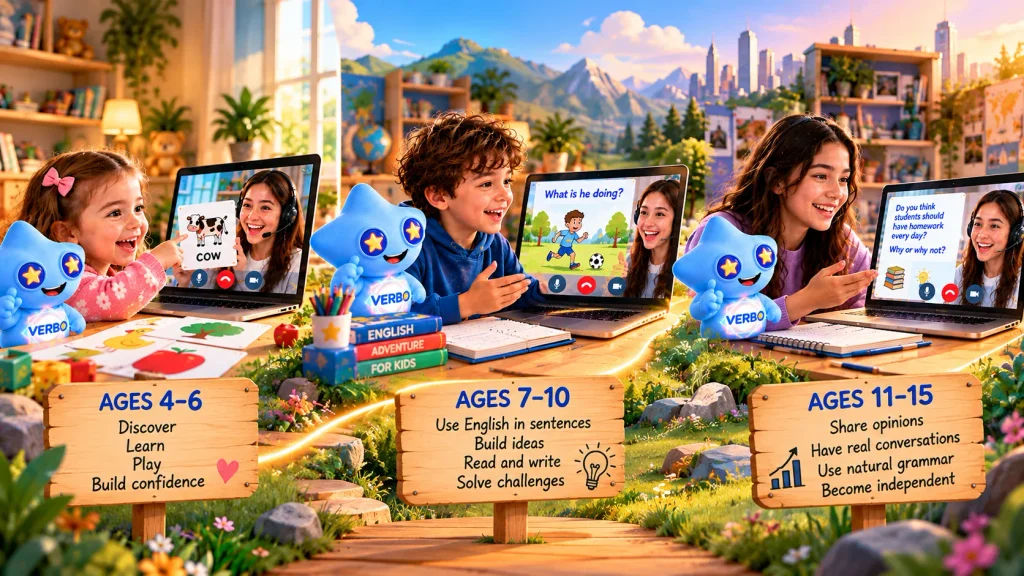
Ages 4–6: English should feel like discovery
For a four- or five-year-old, English should not feel like another school subject.
At this age, children learn through pictures, voices, movement, repetition, imagination and play.
Imagine the difference between these two lessons.
In the first, a teacher says:
“Today we are going to learn five animal words.”
In the second, Verbo arrives at a farm and cannot find his animal friends.
A cow appears.
The teacher asks:
“What is it?”
The child may not know yet.
The teacher says:
“Cow.”
The child repeats:
“Cow!”
Then the cow disappears behind a barn.
“Where is the cow?”
Now the child is not simply memorising a word.
They are listening because they want to know what happens next.
That is the difference.
For younger children, the lesson should feel like something they are inside, not something happening in front of them.

At 4–6, the first goal is not perfect grammar
Parents sometimes worry when a young child gives one-word answers.
But one word can be exactly where speaking begins.
The teacher asks:
“What colour is the ball?”
The child says:
“Red.”
That is already communication.
Later, the teacher can model:
“It is red.”
And the child begins to repeat the full sentence.
Eventually, they may say it independently.
This progression matters more than forcing a child to produce language before they are ready.
At this age, we want children to build a foundation of listening, useful vocabulary, simple sentence patterns, pronunciation, phonics and — just as importantly — the feeling that speaking English is safe.
A child who enjoys trying is easier to teach than a child who is afraid of getting the answer wrong.
Ages 7–10: It is time to turn words into ideas
By the time many children reach primary-school age, their learning can become more structured.
They can usually follow longer instructions.
They can remember more information.
They may be developing stronger reading skills.
And they can begin doing something especially important:
using English to explain things.
A younger child might say:
“Dog.”
A slightly older learner might say:
“The dog is running.”
Then:
“The dog is running because it wants the ball.”
The language is growing, but so is the thinking.
This is where English should begin moving beyond simply identifying vocabulary.
The child should start connecting vocabulary with grammar, reading, speaking and meaning.
Knowing 100 words is not the same as being able to use them
A child may know:
park, football, friend, Saturday
But can they say:
“I played football with my friend at the park on Saturday.”
That is the skill we want to build.
A good teacher does not simply keep giving the child more words.
They help the child do more with the words they already know.
For example:
Teacher: What did you do yesterday?
Child: Football.
Teacher: You played…
Child: I played football.
Teacher: Who did you play with?
Child: I played football with my brother.
One word becomes a sentence.
The sentence becomes a conversation.
And the child begins relying less on the teacher to speak for them.

This is also where lessons need to stay fun without feeling babyish
A nine-year-old still needs imagination.
But they may no longer be interested in exactly the same activities as a five-year-old.
Stories can become more complex.
Challenges can require memory or reasoning.
The child can predict what happens next.
They can describe characters.
They can explain choices.
They can solve a small mystery.
They can role-play a situation.
This is where Verbo can grow with the learner too.
For a younger child, Verbo might lose a toy.
For an older child, Verbo might be preparing for a trip and need advice.
Instead of:
“What is this?”
the teacher can ask:
“What should Verbo take with him, and why?”
Now the child is using English to make a decision.
That is a much richer use of the language.
You can learn more about the philosophy behind our lessons on the About VerbaKid page.
Ages 11–15: English should start becoming their voice
Teenagers need a different kind of lesson again.
They are developing stronger opinions.
They care more about whether something feels relevant.
And they notice immediately when an activity feels designed for a much younger child.
At this stage, English should become more personal.
Instead of asking:
“What is your favourite food?”
for the hundredth time, the teacher can ask:
“Would you rather live in a big city or a small town? Why?”
Or:
“Do you think students should have homework every day?”
Or:
“What makes a good friend?”
Now the student has to think.
They need vocabulary.
They need grammar.
They need to organise an answer.
They need to explain a reason.
And they need to respond to another person’s ideas.
This is where English begins to feel less like a subject and more like a real language.

Teenagers may need confidence even more than younger children
A teenager can know exactly what they want to say and still remain silent.
Why?
Because older children often become more aware of mistakes.
They may worry about pronunciation.
They may worry about grammar.
They may compare themselves with classmates.
They may think:
“What if I sound stupid?”
That is why the teacher’s reaction is important.
Suppose the student says:
“I think school uniforms is good because…”
The teacher could interrupt immediately.
Or the teacher could let the student finish and then naturally model the correct form:
“Yes, school uniforms are good because…?”
The correction still happens.
But the conversation survives.
At VerbaKid, we do not believe confidence means ignoring grammar.
And we do not believe grammar should come at the cost of confidence.
The two should grow together.
The biggest change from age 4 to 15 is independence
When a child is very young, the teacher may do much more of the guiding.
The teacher asks the question.
The child gives a word.
The teacher builds the sentence.
The child repeats.
As the child grows, that balance should gradually change.
A stronger learner begins answering without prompts.
Then explaining.
Then asking their own questions.
Then keeping the conversation alive themselves.
Eventually, the teacher is no longer helping the child construct every thought.
The child owns more of the language.
That is the direction we want.
Not simply:
more difficult worksheets.
But:
more independent communication.
Age matters — but the individual child matters even more
Two ten-year-olds can need completely different lessons.
One child may understand almost everything but hesitate to speak.
Another may speak confidently but struggle with reading.
Another may have a large vocabulary but weak grammar.
And another may simply be bored because the material is too easy.
This is one reason VerbaKid uses live 1-to-1 lessons.
A teacher can pay attention to the actual child in front of them.
They can slow down.
Speed up.
Change the question.
Give an extra example.
Challenge a stronger learner.
Help a shy learner expand a one-word answer.
A child’s age gives us useful information.
But it does not tell us everything.
Parents can explore the different learning paths on our English courses for children page.
A 30-minute lesson should look different at every stage
Imagine the same 30-minute lesson given to three children.
For a five-year-old, the teacher may change activity several times: greeting, story, vocabulary, movement, phonics, speaking and a quick final challenge.
For a nine-year-old, one story can connect multiple parts of the lesson. New vocabulary may lead into reading, questions and sentence-building.
For a fourteen-year-old, the class may spend much longer exploring one idea. The student reads something short, discusses it, learns new expressions and then uses those expressions in conversation.
The clock may still say 30 minutes.
But the lesson should feel completely different.
That is what age-appropriate teaching really means.
What should never change?
The activities should change.
The language should change.
The difficulty should change.
The level of independence should change.
But some things should remain consistent from age four to fifteen.
Every child should have a teacher who listens.
Every child should have enough time to answer.
Every child should be allowed to make mistakes.
Every child should have meaningful opportunities to speak.
And every child should feel that progress is possible.
That is the foundation underneath everything else.
Parents need different roles as children grow too
A four-year-old may need a parent nearby to help them get settled before an online lesson.
At eight, the parent may simply ask:
“What did you learn today?”
At fourteen, the student may want more independence.
That is healthy.
Parents do not need to sit beside a teenager for every class.
But they should still be able to understand the learning journey.
That is why VerbaKid provides a Parent Portal, helping families stay connected to their child’s lessons and progress.
And parents who want simple ways to support English at home can explore our Parent Tips without turning home into another classroom.
How can you tell if an English course is really right for your child’s age?
Do not judge a course only by whether it says “ages 4–15.”
Look at what actually happens during the lesson.
Ask whether your child gets enough speaking time, whether the teacher adjusts the difficulty, whether the content feels appropriate for their age and whether your child is gradually becoming more independent.
A five-year-old should not be sitting through a teenage grammar lecture.
And a fourteen-year-old should not feel like they are completing a preschool worksheet.
The lesson should change because the child has changed.
From “dog” to a real conversation
Imagine the journey.
At four:
“Dog.”
Then:
“It’s a dog.”
Later:
“The dog is running.”
Then:
“I think the dog is running because it wants to play.”
Years later, that same child may be discussing their opinions, telling stories, asking questions and having a natural conversation entirely in English.
That is not simply a child learning harder vocabulary.
That is a child learning to use a language.
And that is what the journey from four to fifteen should look like.
At VerbaKid, we want the learning experience to grow as the child grows.
Different ages.
Different lessons.
Different challenges.
But the same goal:
helping children find their English voice.
And along the way, Verbo can remain a familiar friend — from the first hesitant word to the confident conversation. ⭐
If you are not sure what kind of lesson is right for your child’s age or current level, you do not have to figure it out alone.
You can begin with a free 30-minute VerbaKid trial lesson and let your child experience a live 1-to-1 class with a real teacher.
Because the best English lesson is not simply appropriate for a child’s age.
It understands who that child is today — and helps them become a stronger communicator tomorrow.